
Magnetic Charger Stand vs Regular Charger: Which One Should You Actually Buy?
Most people do not think much about how they charge their phone until something starts annoying them. Maybe the cable falls out every night. Maybe the port on their phone is getting loose after two years of plugging in the same cord. Maybe they just want a cleaner desk, and the tangled wire situation has finally become too much. Whatever brought you here, the question is a fair one: is a magnetic charger stand actually worth switching to, or is it just a more expensive way to do the same thing?
The honest answer depends on how you use your phone, what device you have, and how much charging speed matters to you day to day. Here is a real breakdown with no brand fluff.
What Is a Magnetic Charger Stand, Exactly?
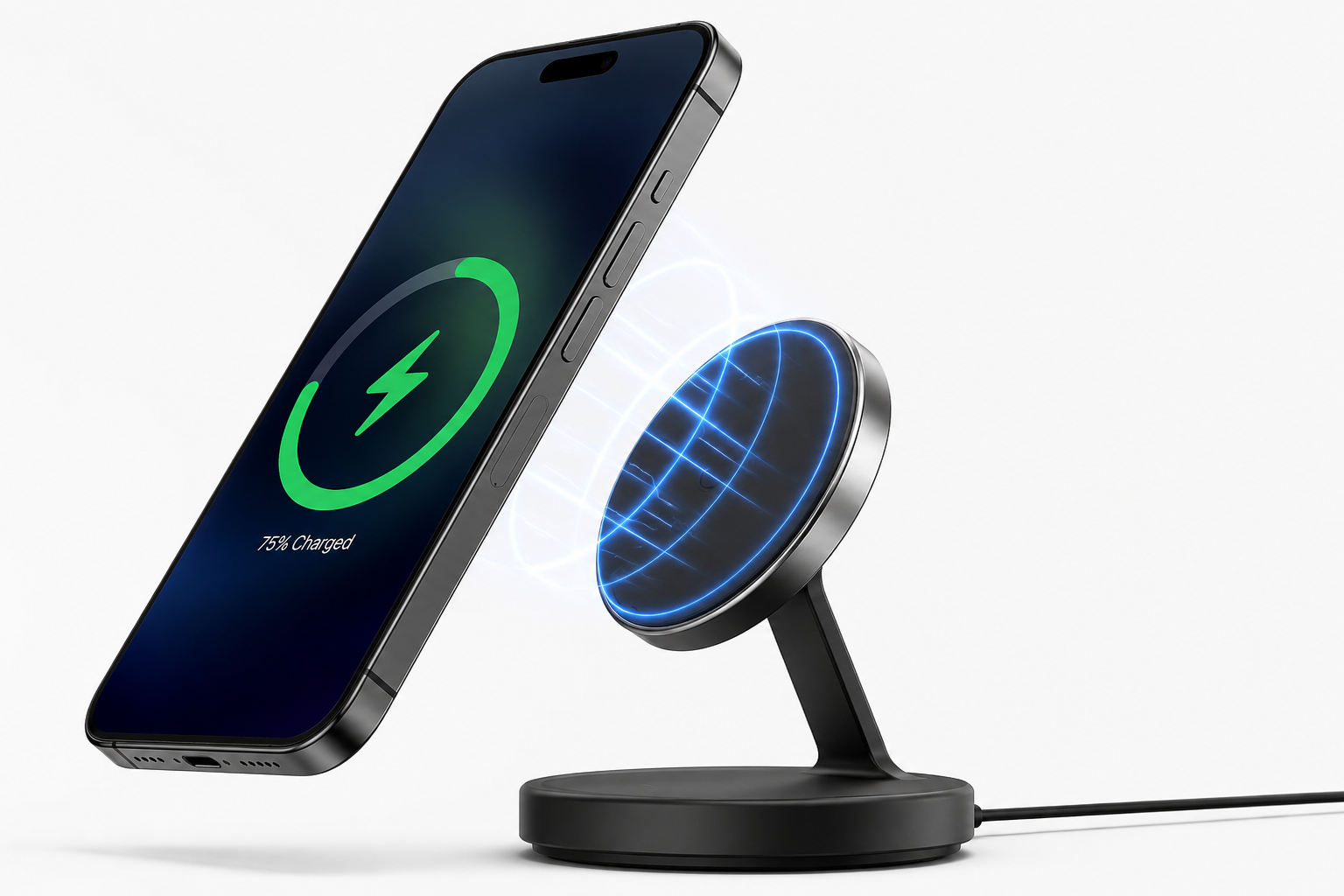
A magnetic charger stand is a wireless charger with built in magnets that snap your phone into the correct position automatically. Instead of carefully placing your phone on a flat pad and hoping the coils align, the magnets guide the phone into perfect contact the moment it gets close. It usually holds the phone upright at a viewing angle so you can see the screen while it charges, which is where the “stand” part comes in.
The technology behind most magnetic charger stands is either MagSafe (Apple’s version, built into iPhones from iPhone 12 onward) or Qi2 (the open standard version that works across Android phones like Samsung Galaxy S24 and Pixel 9 as well). Both deliver the same 15 watts of wireless charging speed. Qi2 is typically cheaper and works across more devices, while MagSafe is exclusive to Apple products.
What Counts as a “Regular Charger”?
A regular charger is a cable plugged directly into your phone’s USB C or Lightning port, connected to a wall adapter or power bank. Simple, direct, and familiar to everyone. Some wall adapters support fast charging at 20, 25, or even 45 watts depending on the phone and adapter.
There is also standard Qi wireless charging, which is the flat pad style that has existed for years. This is neither magnetic nor a stand, and it often gets confused with magnetic charging in comparisons. They are not the same thing. Old Qi pads have no magnets, charge at 7.5 watts on iPhones, and require careful placement or charging can stop mid night from the slightest shift.
Speed: The Part Everyone Wants to Know First
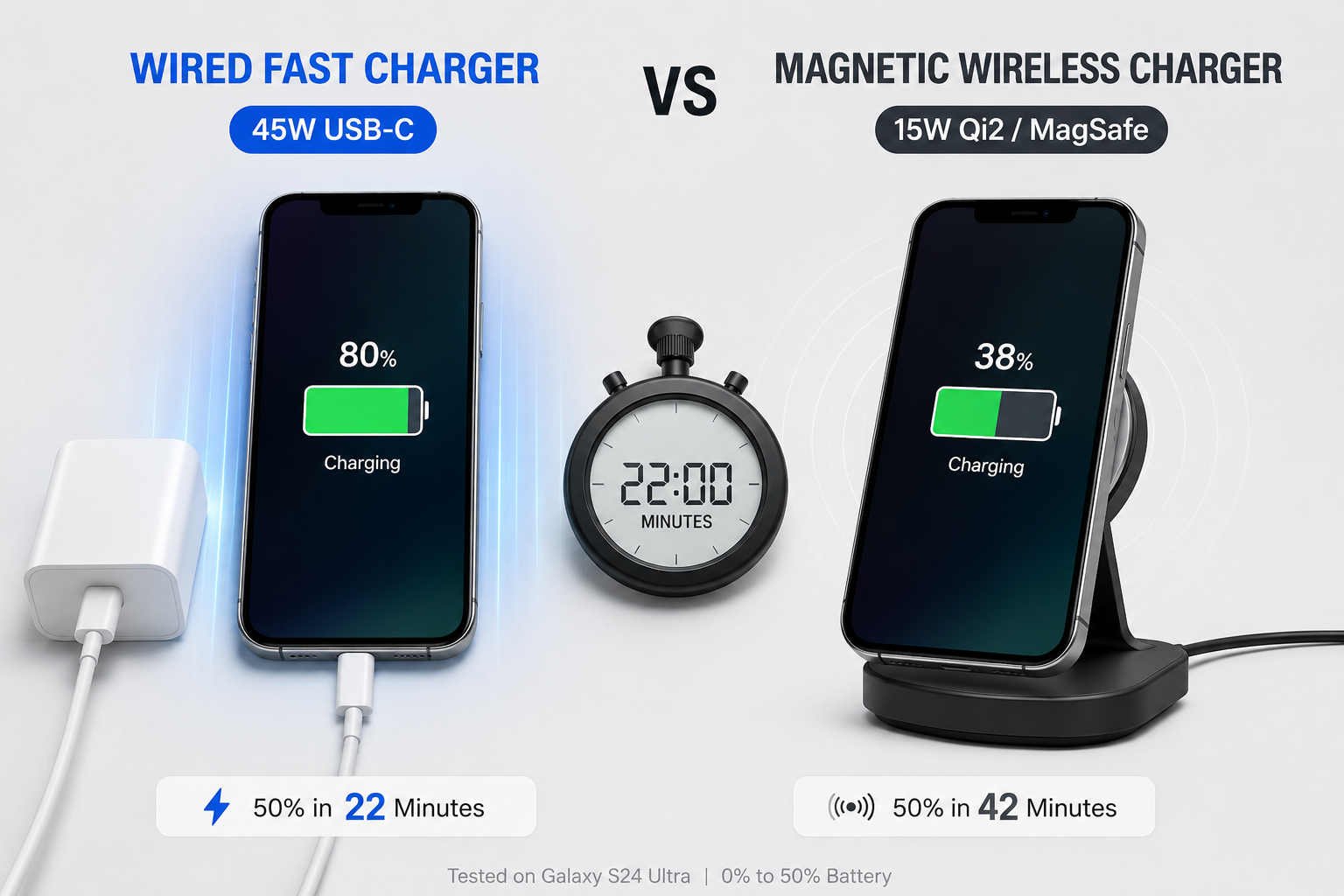
Wired charging wins on raw speed, and by a noticeable margin in real life tests. Getting from zero to fifty percent takes roughly 22 minutes on a Samsung 45W wired setup compared to around 42 minutes on a Qi2 or MagSafe 15W magnetic charger. Standard Qi without magnets is even slower, capped at 7.5 watts on iPhones before the iPhone 12.
What this means in practice: if you are in a rush, need to top up before walking out the door, or regularly find yourself at 10 percent battery with 20 minutes to spare, a wired charger will get you more battery in less time. A magnetic stand charging at 15 watts is roughly twice as slow as a proper wired fast charger.
However, most people do not charge their phone in a rush. They charge overnight or leave it on the desk for hours while working. In that context, the speed difference stops mattering. Whether it reaches 100 percent in 1.5 hours or 2.5 hours is irrelevant if you are not watching it.
Alignment and the Problem Nobody Talks About With Old Wireless Pads
The biggest real world frustration with standard Qi wireless charging is not the speed. It is waking up to find the phone at 43 percent because it shifted half a centimeter during the night and disconnected. Misalignment does not just slow down charging. It also causes the charger and phone to generate excess heat because the system is working inefficiently, which over time is worse for battery health than slow charging.
Magnetic charger stands solve this completely. The magnets snap the phone into the correct coil position every time, which means charging starts instantly and stays consistent. There is no adjusting, no guessing, no mystery flat battery in the morning.
This is the actual strongest argument for switching to a magnetic stand, not the aesthetics or the tech appeal, just the reliability of knowing it will charge every single time you set it down.
Battery Health: Which One Is Gentler Over Time?
Wired charging generates heat too, but because the heat comes from the adapter and travels through a cable, less of it transfers directly to the phone. Wireless charging generates heat at the point of contact, which is against the phone’s back glass, closer to the battery.
Research suggests wireless charging causes roughly 3 to 5 percent more battery capacity loss over two years compared to wired charging. Modern phones manage this with thermal regulation, so it is a real but minor difference rather than a serious concern for most users. If you keep phones for four or five years and battery longevity is genuinely important to you, a wired charger is the safer long term choice. For most people on a one to two year phone cycle, it is not a deciding factor.
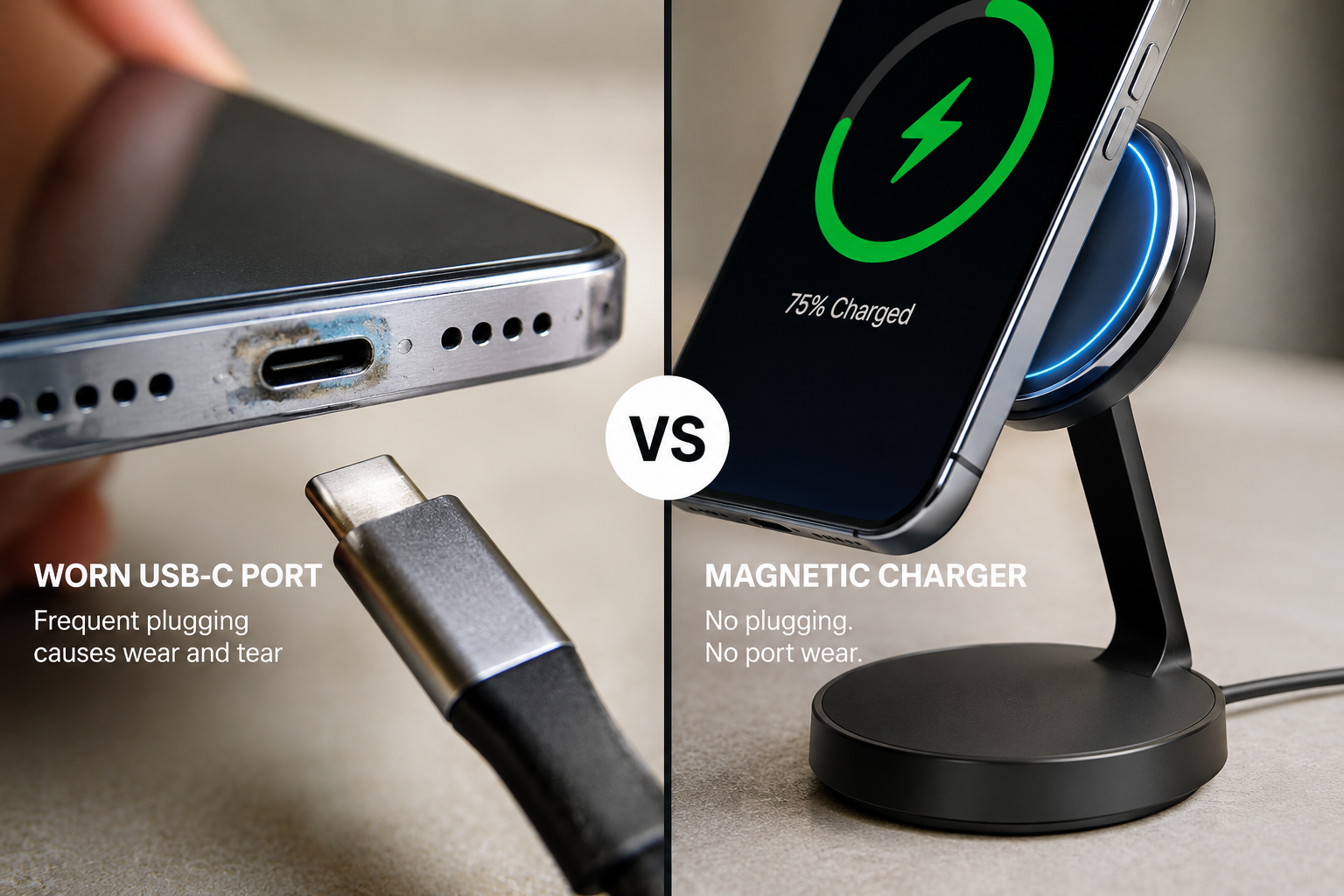
What magnetic charging does help with is port wear. Plugging and unplugging a USB C cable dozens of times a week gradually loosens the port connection. It is rarely dramatic, but after a year or two of daily cable use it shows up as a slightly wobbly connection or the charger needing to be held at a specific angle. Magnetic stands eliminate this entirely since the port never gets touched during overnight charging.
Case Compatibility: The Thing to Check Before You Buy
Magnetic charger stands work through most thin phone cases under 3 to 5mm. If your case is thicker, has a built in card holder, or uses any metal plate or magnetic ring for a separate car mount, it will likely interfere with charging.
Thick rugged cases and metal-backed cases are the main incompatibility issues. If you use a thin silicone or plastic case, you will almost certainly be fine. MagSafe cases with their own built in magnets offer the most secure snap and fastest charging. Third-party magnetic ring accessories are available for Android phones that do not natively support Qi2, though results vary by phone model.
Which One Wins for Different Types of Users?
For the person who charges overnight and wants a clean desk setup, a magnetic stand is genuinely the better daily experience. The phone sits visible at an angle, starts charging the moment it is set down, and there are no cables to deal with. The slower speed is completely irrelevant.
For someone who regularly needs to charge quickly from a low battery, a wired fast charger gets more power into the phone faster and is the practical choice. Keeping one wired adapter at work or in a bag alongside a magnetic stand at home is actually a smart combination many people settle on.
For someone with an older iPhone (before iPhone 12) or a budget Android without Qi2 support, magnetic charging is either not compatible or requires an add on ring that is not always reliable. A wired charger or a basic Qi pad is the more sensible buy.
For people who travel frequently, a compact portable power bank that supports magnetic charging gives you magnetic convenience on the go, and pairing it with an international power adapter for the wall charging side covers most scenarios without bringing multiple cables.
What About Desk Setup and Aesthetics?
This matters more than people admit. A magnetic stand sits on your desk at a fixed angle, keeps your phone visible for notifications and calls, and has no cable snaking across the surface. For anyone working at a home setup or a tidy desk, it looks significantly cleaner than a charger cable draped over the edge. If your desk setup includes a laptop and a portable monitor, having one organized charging spot rather than loose cables improves how the whole setup feels to use.
Regular chargers look utilitarian because they are. That is fine for a nightstand or a kitchen counter where nobody is staging a photo, but for a visible workspace it is a different experience.
The Price Reality
A decent magnetic charger stand from a reputable brand sits between $20 and $50 depending on whether it charges one device or three. Budget options from lesser known brands drop closer to $10, though build quality and heat management become genuinely concerning below $15. Budget wired chargers start under $10 and reliably deliver fast charging speed without much risk.

Anker MagSafe Compatible MagGo Charger Stand
The price gap matters less over time than people expect. A magnetic stand used daily for two years while protecting your phone’s charging port from repeated plugging is arguably more economical than replacing a cable twice and eventually repairing a worn USB C port.
Frequently Asked Questions
Will a magnetic charger stand work with my Android phone?
If your Android supports Qi2, yes, natively. If not, you can add a magnetic ring accessory to the back of your phone, but check your specific model for compatibility. Samsung Galaxy S24 and Pixel 9 series support Qi2 without any extras.
Can I use my phone normally while it is on a magnetic stand?
Yes, that is one of the practical benefits. The phone sits upright at a usable angle so you can read notifications, take video calls, or use it in landscape mode while it charges. This works with iOS StandBy mode on iPhones too.
Is a magnetic charger safe to leave on overnight?
Yes, modern magnetic chargers from reputable brands include protection against overheating, over voltage, over current, and foreign object detection. Look for FCC certification or similar safety markings on the listing.
Does it matter which wall adapter I use?
Yes, more than people realize. To get the full 15W speed from a magnetic stand, you need a power adapter rated at 15W or higher, ideally a 20W USB C PD adapter. Using a slow 5W adapter will charge the phone but not at the speed the stand supports.
What if my case is too thick for magnetic charging?
You have two options: switch to a thinner case or remove the case while charging. Some people charge caseless on the stand overnight and put the case back on in the morning, which is a simple enough routine once it becomes a habit.
The Bottom Line
A magnetic charger stand is a better daily charging experience for most people who already have a compatible phone. The snap alignment solves the actual frustrations of wireless charging, the upright angle makes the phone genuinely useful while charging, and the desk setup looks cleaner than any cable can manage.
A regular wired charger is still faster in a hurry and is the smarter buy if you have an older phone, a very thick case, or a lifestyle where you regularly need to charge from near zero in under an hour.
If you are already using a wireless pad and finding it unreliable, switching to a magnetic stand is an immediate upgrade. If you have never tried wireless charging at all, a magnetic stand is the version worth starting with rather than an old flat Qi pad that may have been why people gave up on wireless charging in the first place.