
How to Choose a Power Bank with Built-in Cables: Buyer’s Guide
Somewhere in a bag or kitchen drawer, most people have at least one charging cable they cannot fully trust. It charges sometimes. It needs to be held at a specific angle. It worked fine six months ago and now it sort of works. The built-in cable power bank exists partly because people are tired of dealing with that situation, and partly because losing a cable the night before a trip has happened to almost everyone at least once.
A power bank with built-in cables integrates one or more charging cables directly into the device body, typically USB-C, sometimes Lightning, occasionally both, so the cable is always there when you need it. No digging through bags. No discovering the cable you packed does not actually support fast charging. Just pick it up and plug in.
But not all of these devices are built the same way, and buying the wrong one is a genuinely frustrating experience. Some advertise enormous capacity numbers that do not match real world performance. Others include every cable type imaginable but charge so slowly the numbers barely matter. A few have cables that fray at the connection point within a few months of daily use. This guide covers what actually matters when choosing one, so you can skip the guesswork.

Why the mAh Number on the Box Is Only Part of the Story
Capacity is the first thing most people look at, and it is also the most commonly misrepresented spec in this category. The mAh rating on the packaging reflects the internal cell voltage of 3.7V, not the usable energy delivered to your phone at the higher voltages charging actually requires. Due to conversion losses, voltage stepping, and cable resistance, a 20,000 mAh power bank typically delivers only 12,000 to 13,500 mAh to a smartphone under real conditions.
This means a bank rated at 20,000 mAh will not give your phone four full charges even if the math suggests it should. Realistically, expect about 60 to 75 percent of the nominal capacity to be available for charging devices.
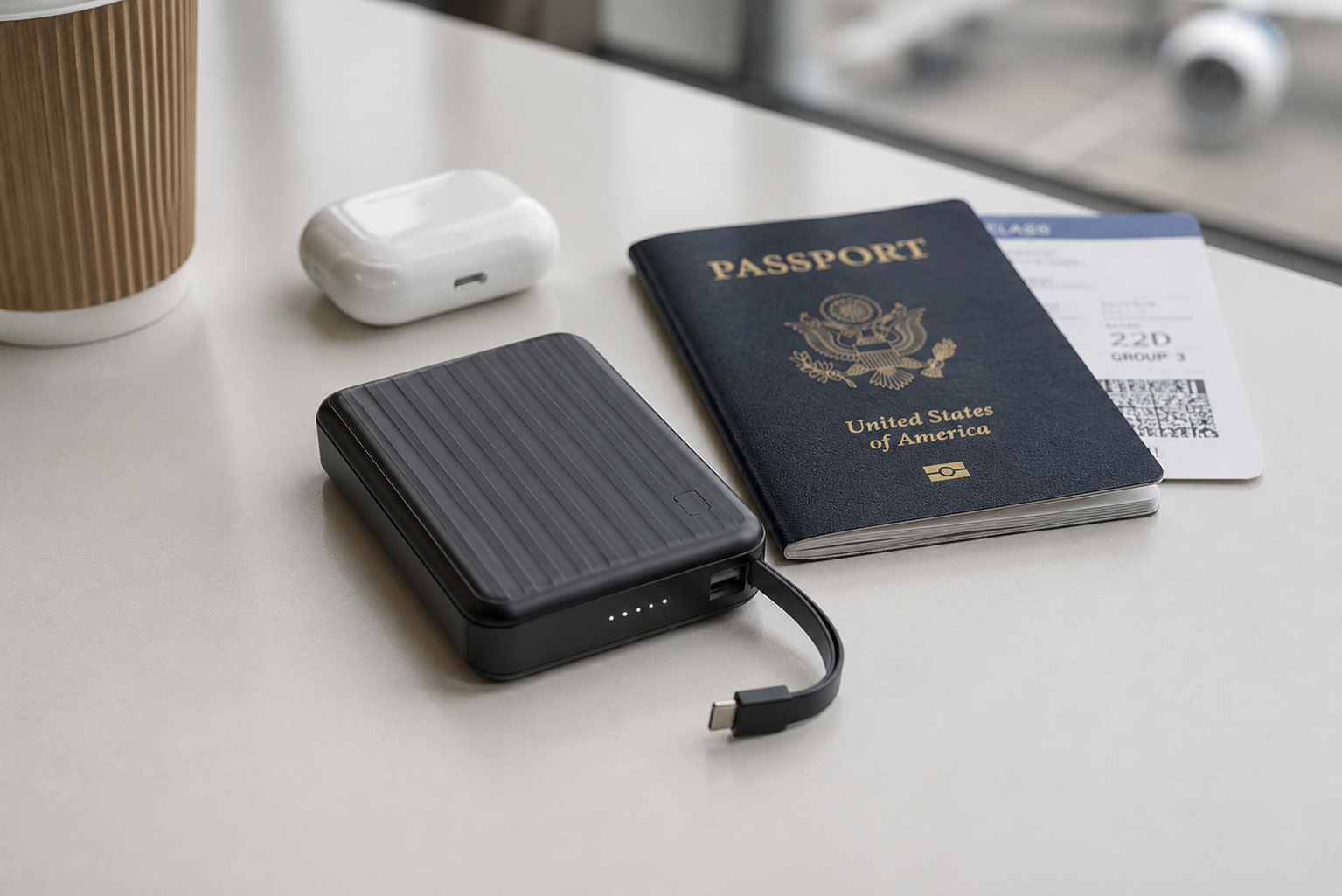
The more honest number to look for is watt-hours, abbreviated as Wh. This tells you the actual usable energy stored. It also matters for travel because a true 20,000 mAh unit at 3.7V equals 74 Wh, which falls below the 100 Wh airline carry-on limit. Brands that publish their watt-hour rating clearly tend to be more trustworthy overall. If a listing only shows mAh and skips the Wh figure entirely, that is worth noting before you buy.
For everyday use, a 10,000 mAh model is the sweet spot for most people. The best power bank with built-in cable for most people is a 10,000 mAh model with USB-C Power Delivery, a built-in USB-C cable, and a realistic output rating around 18W to 30W. If you travel regularly or charge more than one device throughout the day, stepping up to 20,000 mAh makes more sense than pushing to the highest capacity available.
The Built-in Cable Itself Matters More Than Most Listings Suggest
The cable is the whole point of buying this type of power bank, which makes it surprising how rarely product listings explain how the cable is constructed. This is where many budget options quietly fail within months rather than years.
Built-in cables fail far more often than external ones, not because they are inherently weaker, but because they endure constant bending at fixed hinge points near the housing. In durability testing, 68 percent of units failed cable integrity before 500 flex cycles. Compare that to detachable cables, which typically last through 5,000 or more flex cycles, and the gap becomes significant for anyone who uses a power bank daily.
What separates cables that hold up from ones that do not comes down to a few construction details. Strain relief, meaning the reinforced section where the cable meets the housing, is the most important. Units lacking proper strain relief failed 4.2 times faster in bend tests. Conductor gauge matters too. Thinner 28 to 30 AWG cables lose voltage over the cable’s length at higher current draws, which can actually stall fast charging negotiation between the bank and your device even when both support it.
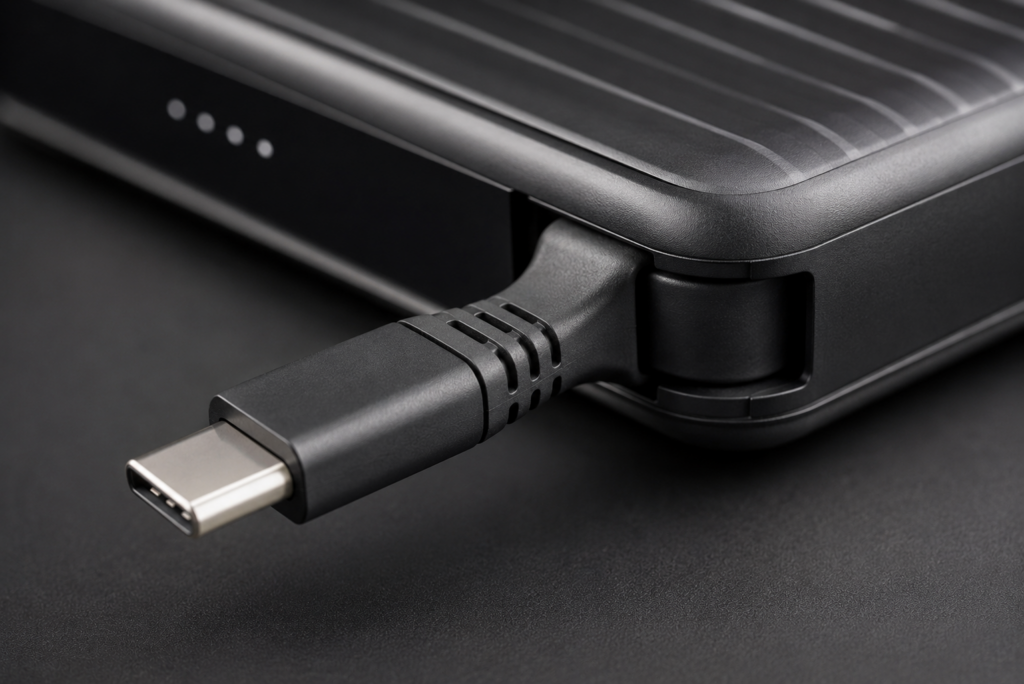
When evaluating a specific model, look for whether the cable is retractable with a locking mechanism or simply attached with a rubber bend guard. Physical cable retention via a locking mechanism is more reliable than a rubber hinge design over extended daily use. Retractable designs that click into place keep the cable from flopping around in your bag and reduce the repetitive bending stress that wears cables out.
Charging Speed: What USB-C PD Actually Means for You
Fast charging with a built-in cable power bank depends on three things working together: the power bank’s output rating, the cable’s data and power capacity, and your device’s charging protocol. When any of these three are mismatched, you charge slower than you should.
USB Power Delivery, commonly written as USB-C PD, is the standard that allows higher wattage charging across modern phones, tablets, and laptops. A power bank that supports USB-C PD at 18W or higher will charge a compatible phone significantly faster than a standard 5W output, often reaching 50 percent in roughly 25 to 30 minutes instead of an hour or more.
Qualcomm Quick Charge, or QC, is a separate fast charging standard common across many Android devices. Some power banks support both PD and QC, which gives broader compatibility across device types. If you use a Samsung, Google Pixel, or most mid to high range Android phones, confirming the bank supports the charging standard your phone uses matters more than the raw wattage number alone.
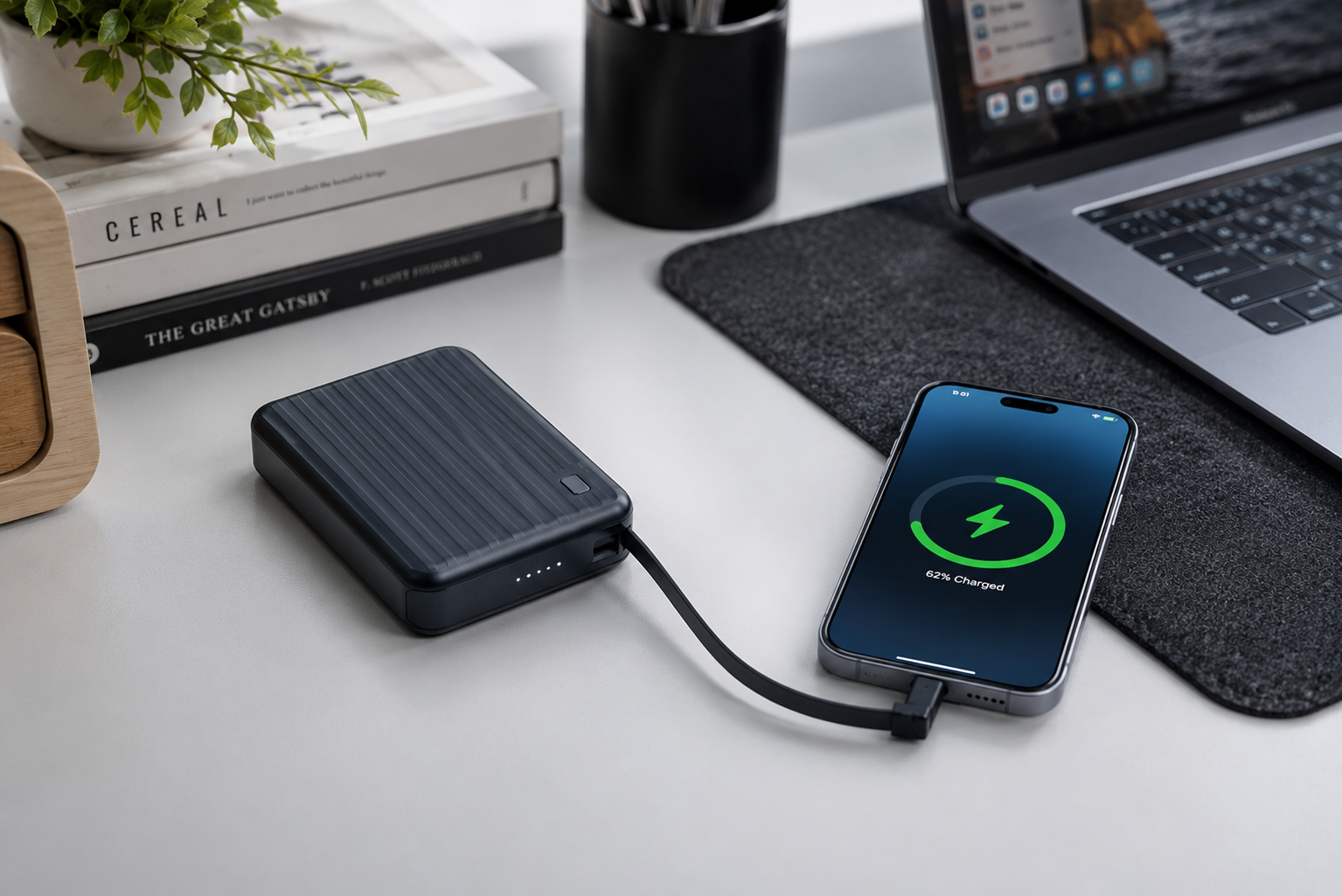
The difference between 18W and 22.5W in real world charge time for most phones is not meaningful enough to be a deciding factor. What does matter is whether the fast charging standard is genuinely supported versus simply listed as a feature. Reading verified buyer reviews that mention actual charge times tends to reveal this faster than spec sheets alone.
Cable Types and Compatibility: Matching the Bank to Your Devices
Built-in cable designs come in a few distinct configurations, and picking the wrong one for your device lineup creates the exact inconvenience you were trying to avoid.
Single USB-C is the most common and the most practical for anyone using a modern Android phone, newer iPad, recent MacBook, or most USB-C laptops. Single-cable models cover around 78 percent of daily charging needs, particularly where USB-C adoption in mid-tier phones has crossed 90 percent. If everything you regularly charge uses USB-C, this is the cleanest option with the least complexity.
Dual cable designs that combine USB-C with Lightning make sense for people who regularly switch between Android and iPhone or who charge Apple earbuds alongside an Android phone. Dual cable designs often combine USB-C plus Lightning or USB-C plus Micro-USB, covering major smartphone ecosystems but with bulkier design and more stress points.
Multi-cable banks advertising three or four built-in cable types sound appealing in theory. In practice, real world testing shows none of the top five sellers in this configuration maintain full functionality beyond six months of daily use. The more cables packed into one unit, the more failure points exist, and the less battery density the unit can achieve in the same physical size. If you genuinely need to charge multiple cable types regularly, a single cable bank with an extra port for a separate cable you carry loosely tends to be more reliable long term.
Recharging the Power Bank Itself
This step gets overlooked until you are somewhere without a power outlet and realize the bank is nearly empty. How quickly a power bank recharges matters as much as how quickly it charges your devices, especially for regular travelers.
Look for a USB-C input rating at the same level as the output, ideally 30W or higher for a 20,000 mAh unit. Banks that accept only 5W or 10W input will take six to eight hours to fully recharge, which is inconvenient if you rely on them daily. A true 3-in-1 design that combines a power bank, a wall charger with foldable plug, and a built-in cable can recharge from any outlet in around three hours, which eliminates carrying a separate wall adapter and makes airport and hotel charging significantly simpler.
If you travel internationally, pairing a built-in cable power bank with a reliable international power adapter matters because the power bank still needs to recharge from a wall socket, and wall sockets vary by country. A bank with a built-in fold out wall plug solves this for domestic travel but typically covers only one plug standard.
Size, Weight, and Whether It Actually Fits Your Routine
A power bank you do not carry is not useful, which makes physical size a practical consideration rather than a secondary one. A 20,000 mAh unit with a built-in cable often weighs more than a 20,000 mAh traditional bank due to structural reinforcement around the cable mechanism. Reading verified buyer comments about real world pocketability tends to be more accurate than the listed weight alone.
For daily commuting and single device charging, a 10,000 mAh bank that fits in a jacket pocket or the outer pocket of a bag gets used consistently. A larger, heavier 25,000 mAh bank tends to stay in a travel bag and gets used on trips rather than daily. Being honest with yourself about which category describes your actual behavior prevents buying more capacity than you will ever carry.

10,000mAh 30W Power Bank
If you regularly work from a desk or bedside table, a bank with a built-in kickstand or a design that holds the phone upright while charging is worth considering. It makes the power bank more useful in stationary situations and gives it more daily value than a flat slab that only works while you are moving.
Safety Certifications: The Spec Nobody Reads Until Something Goes Wrong
Lithium ion batteries under charging stress generate heat, and a poorly designed power bank manages that heat badly. The certifications to look for on a listing are UL, CE, and FCC marks, which indicate the unit has been tested against recognized safety standards for overcurrent, overcharge, short circuit, and temperature protection.
Certified models undergo rigorous testing and are less likely to damage devices or pose fire risks. Unbranded units from unknown manufacturers that list no visible certification and price aggressively below the market average tend to omit these protections. A power bank charging your phone in a bag overnight is not the product to buy based on the lowest price on a search results page.
Mild warmth during charging is normal. Excessive heat above 45 degrees Celsius indicates poor thermal design, aging cells, or an incompatible cable, and is a signal to stop using the unit and verify specifications. Brands with consistent third party review coverage, such as Anker, Ugreen, and Baseus, tend to have documented real world performance that makes their safety claims verifiable rather than theoretical.
Choosing by Use Case
For a student or daily commuter charging one phone throughout the day, a 10,000 mAh single USB-C cable bank from a reputable brand is the right size, right weight, and right level of complexity. No extra features needed.
For a remote worker or someone who charges a phone and wireless earbuds regularly, a 10,000 to 15,000 mAh dual cable bank or a single cable bank with an additional USB-A port gives enough flexibility without becoming bulky.
For frequent travelers charging a phone, tablet, and potentially a laptop, a 20,000 mAh bank with USB-C PD output and a fast input rating becomes worth the extra size and cost. Confirm the watt-hour rating is under 100 Wh for airline compliance and check whether the bank supports the wattage your laptop actually needs before assuming it will charge at a useful speed. If your travel desk setup includes a portable monitor or other USB-C accessories, choosing a bank with two output ports lets you power multiple things simultaneously without carrying two separate banks.
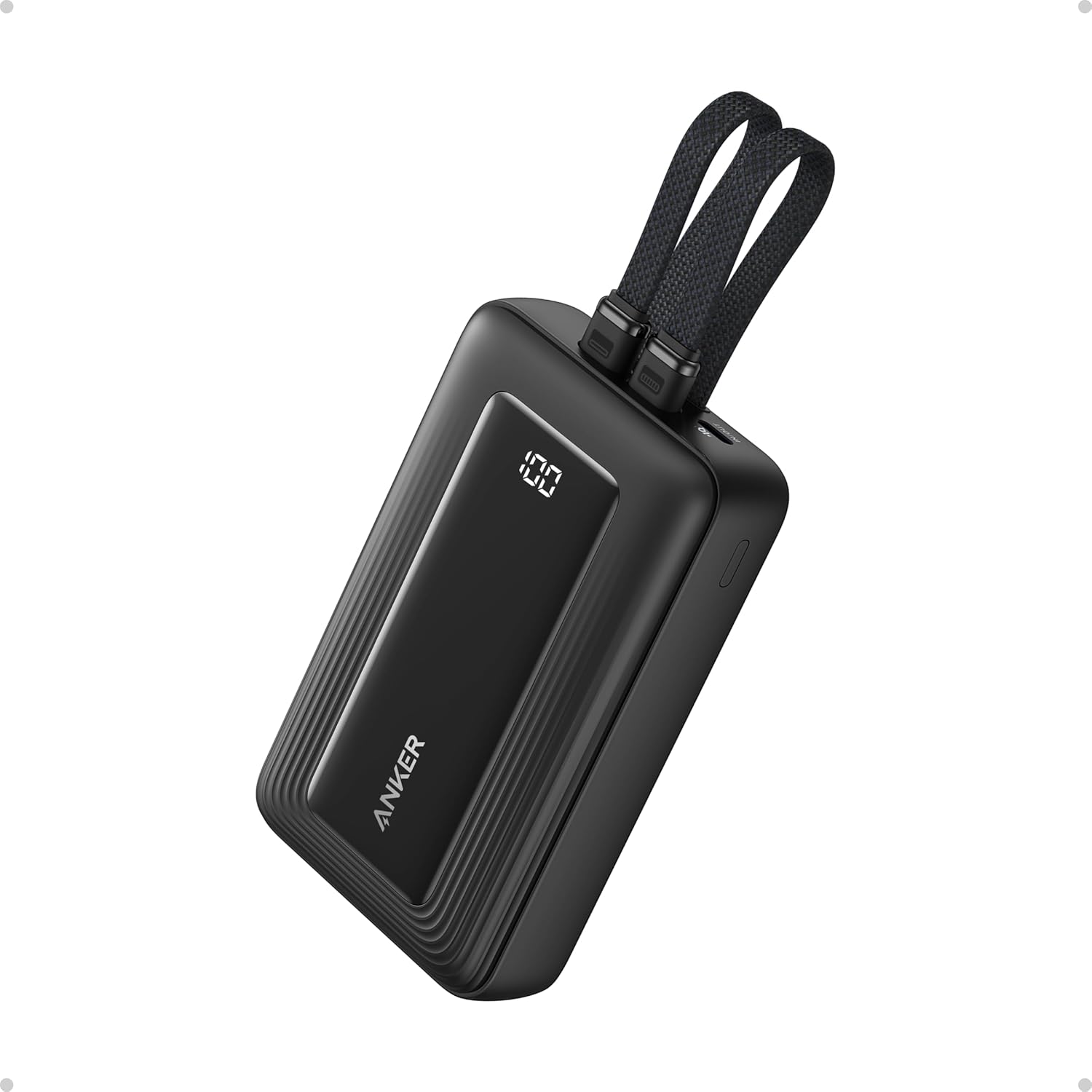
20,000mAh 30W Max Fast Portable Charger
For people focused on keeping their workspace organized, some built-in cable banks pair well with a magnetic charger stand at the desk. The bank handles on-the-go charging while the magnetic stand takes over the overnight routine, which keeps cables off the desk entirely.
Frequently Asked Questions
How many times can a 10,000 mAh power bank fully charge my phone? Most modern smartphones have batteries between 4,000 and 5,000 mAh. Accounting for real world conversion efficiency of around 60 to 75 percent, a 10,000 mAh bank realistically delivers one and a half to two full charges rather than the two to two and a half the math might suggest.
Can a built-in cable power bank charge a laptop? Some can, but only if the output wattage is high enough for your laptop’s requirements. Most laptops need at least 45W to charge at a usable rate, with MacBooks often needing 65W or more. Verify both the power bank’s maximum USB-C PD output and your laptop’s minimum charging wattage before assuming compatibility.
Are power banks with built-in cables allowed on airplanes? Generally yes when kept in carry-on luggage. The key threshold is 100 Wh for most airlines. A typical 10,000 mAh bank at 3.7V is around 37 Wh, well within limits. A 20,000 mAh bank sits around 74 Wh, also within the standard limit. Always check the Wh figure on the label and confirm with your airline before flying, as rules can vary by carrier and route.
What happens if the built-in cable breaks? This is the main practical tradeoff of built-in cable designs. The cable cannot be swapped out. If it fails, the bank becomes a standard power bank that needs a separate cable for output, which is why models with at least one additional USB-C or USB-A port are worth prioritizing. The port keeps the bank functional even if the built-in cable eventually wears out.
Is a retractable cable better than a fixed one? Retractable cables with a locking mechanism tend to last longer because the locking position reduces repetitive bending stress at the housing connection point. Fixed cables with good strain relief can also hold up well. The thing to avoid is a cable that flops freely with no strain relief at the housing connection, as that design wears out faster regardless of the cable’s overall construction quality.
How long should a quality built-in cable power bank last? With daily use, a well-built bank from a reputable brand should maintain around 80 percent of its original capacity after 300 to 500 full charge cycles, which typically translates to one to two years of daily use before noticeable capacity loss. The cable often shows wear before the battery does, which is why having an extra port matters as a backup.
The Bottom Line
A power bank with built-in cables solves a real, everyday frustration and does it well when the right model is chosen. The capacity on the box matters less than the watt-hour figure, the fast charging standard compatibility, and the construction quality of the cable itself. A 10,000 mAh single USB-C cable bank from a reputable brand handles most daily needs without adding unnecessary weight or complexity. Anyone charging multiple devices or traveling regularly will benefit from stepping up to 20,000 mAh with dual output options, but should verify real world watt-hour ratings and airline compliance before buying.
The cable will wear before the battery does. Choosing a model with at least one additional port ensures the bank stays useful even after the built-in cable eventually shows its age.